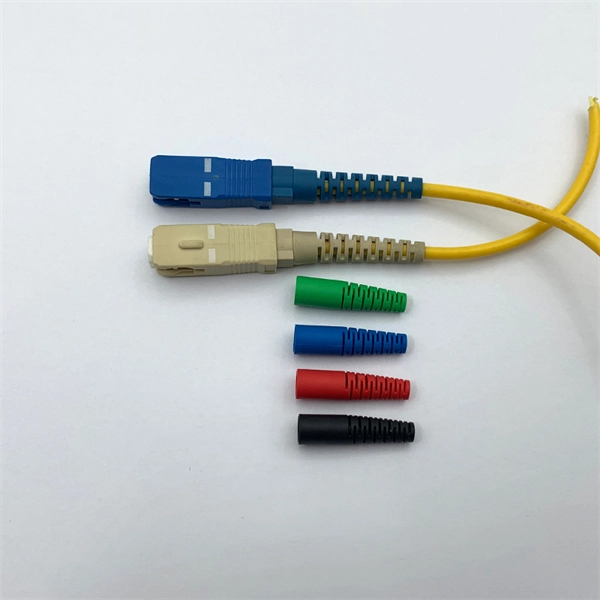
Optical fiber communication equipment transmits data by converting electrical signals into light pulses, guiding them through optical fibers via total internal reflection, and reconverting them back into electrical signals at the receiver.Signal Conversion and Transmission
The process begins with an electrical input signal, typically digital data representing binary 1s and 0s, generated by a transmitter circuit, computer, or telecom device . This signal is fed into a transmitter, which includes a source driver and a light source such as a Laser Diode (LD) or Light Emitting Diode (LED). The source driver amplifies the electrical signal to power the light source, ensuring that each binary state is represented by a corresponding light pulse .
Light Propagation in Optical Fiber
The light pulses travel through the optical fiber, which consists of three main layers:
- Core: The innermost part where light propagates.
- Cladding: Surrounds the core and has a lower refractive index to enable total internal reflection, keeping light confined within the core .
- Coating: Protective layer against physical damage and moisture . The principle of total internal reflection ensures minimal signal loss. Light entering the fiber at an angle greater than the critical angle is reflected entirely within the core, allowing it to travel long distances with very low attenuation . The refractive index difference between the core and cladding is crucial for this effect, governed by Snell's Law.
Signal Reception and Conversion
At the receiving end, a photodetector (such as a photodiode) captures the light pulses and converts them back into electrical signals . The received signal is then amplified and decoded to reconstruct the original data, whether digital or analog. High-speed optical communication can achieve data rates of tens of gigabits per second using semiconductor lasers capable of rapid modulation .
Enhancements for High-Capacity Communication
To increase data capacity, Wavelength Division Multiplexing (WDM) allows multiple light signals of different wavelengths to travel simultaneously through a single fiber, significantly boosting bandwidth without adding more fibers . Single-mode fibers, with a small core diameter, support long-distance, high-bandwidth transmission, while multimode fibers allow multiple light paths for medium-distance applications .
Summary
In essence, optical fiber communication equipment works by modulating light to carry information, guiding it efficiently through fibers using total internal reflection, and reconverting it to electrical signals at the receiver. This technology enables high-speed, long-distance, and interference-resistant data transmission, forming the backbone of modern telecommunications, internet, and cable networks .