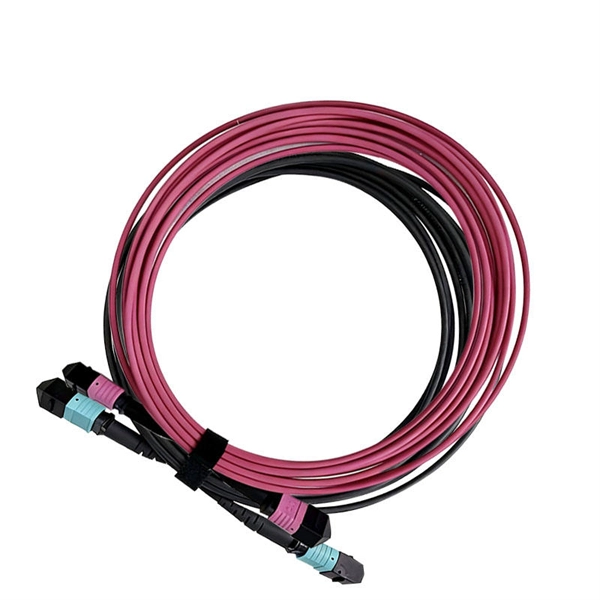
Fiber optic cables have connectors on both ends for direct connections, while fiber optic pigtails have a connector on one end and a bare fiber on the other for splicing.Fiber Optic Cables
Fiber optic cables are high-speed transmission media used to carry optical signals between devices. They consist of one or more strands of optically pure glass fibers, surrounded by protective layers, and are typically terminated with connectors on both ends, such as LC, SC, ST, or MTP/MPO types . These cables can be simplex (single fiber), duplex (two fibers), or multi-fiber (8, 12, 24, or more fibers). They are commonly used to connect optical transceivers, switches, patch panels, and distribution frames, providing reliable long-distance or short-distance connections depending on the fiber type (single-mode or multi-mode), .
Fiber Optic Pigtails
Fiber optic pigtails are short lengths of optical fiber with a factory-terminated connector on one end and a bare, exposed fiber on the other . The bare end is designed to be permanently spliced—either by fusion or mechanical splicing—to incoming fiber cables in the field. Pigtails are typically used in optical distribution frames (ODFs), terminal boxes, or distribution boxes, allowing precise, low-loss connections between bulk fiber cables and active equipment . They are usually shorter than standard fiber cables, ranging from a few meters to tens of meters.
Key DifferencesFeatureFiber Optic CableFiber Optic PigtailConnectorsBoth endsOne end onlyLengthCan be long (meters to kilometers)Short (meters)PurposeDirect connection between devices or panelsSplicing to bulk fiber for equipment connectionApplicationPatch panels, switches, LANs, access networksODFs, terminal boxes, FTTH drop cablesSplicingNot requiredRequired at bare end for permanent connectionApplications and Usage
- Fiber optic cables are used for connecting devices, patch panels, and network modules, providing flexible and reliable links in LANs, data centers, and access networks .
- Fiber pigtails are essential for terminating bulk fiber runs, enabling low-loss splicing to active equipment or patch panels. They ensure consistent connector quality and reduce installation errors .
- Pigtails can be produced by cutting a patch cord in half, but factory-terminated pigtails are preferred for precision and reliability . Understanding the correct use of fiber optic cables and pigtails is crucial for minimizing signal loss, improving network efficiency, and ensuring long-term reliability in optical networks .